Language
But materials science never stands still. As industry experts have observed, the evolution of wheelchair materials has already traced a clear trajectory — from aluminum to titanium to carbon fiber. Today, that trajectory is accelerating toward a new frontier. From aerospace-grade titanium alloys and ultralight magnesium to shape memory alloys, 3D-printed liquid crystal polymers, and graphene-enhanced smart materials, the next generation of rehabilitation equipment is being redefined by materials that are not only lighter and stronger — but smarter, more responsive, and more personalized.
So what comes after carbon fiber? Here are the materials poised to lead the next revolution.
Titanium: The New Standard for Durability and Ride Quality
Titanium has already emerged as a serious contender to carbon fiber in the premium wheelchair segment. Unlike carbon fiber, which can be susceptible to impact damage, titanium offers remarkable durability while maintaining exceptional lightness.
Take the RGK Octane FX, an ultralight titanium wheelchair crafted from Grade 9 titanium and tailored using over 30 individual measurements to ensure optimal posture, propulsion efficiency, and balance. With a transport weight of approximately 5.5 kg and a total assembled weight ranging from 7 kg to 11.5 kg depending on configuration, it demonstrates that titanium can match — and in some cases surpass — the weight savings of carbon fiber.
What truly sets titanium apart is its ride quality. The material’s natural shock-absorbing properties smooth out road vibrations on uneven surfaces, making it ideal for urban travel and outdoor adventures. It’s also exceptionally corrosion-resistant, a critical advantage for users who enjoy beach environments or live in humid climates. The Ki Mobility Catalyst 5Ti takes this further, featuring a patented frame design that delivers what its manufacturer calls “the lightest and strongest titanium folding chair on the market,” with a transport weight of just 5.8 kg.
For Topmedi, which has long been at the forefront of lightweight frame innovation — from aviation-grade aluminum to intelligent control systems — titanium represents a natural next step in delivering durability without compromising portability.
Magnesium Alloy: The Lightest Structural Metal
If titanium represents an evolution, magnesium alloy may be the true revolution in structural lightness. Magnesium is the lightest structural metal available, and recent innovations have made it viable for rehabilitation equipment at scale.
The AeroMg Transit from Drive Medical, for example, achieves a carry weight of just 5.7 kg using a lightweight magnesium alloy frame. Research on all-terrain wheelchairs built with AZ31 magnesium alloy has demonstrated a 25% weight reduction compared to conventional materials, while maintaining structural integrity and functionality under rigorous ISO 7176 testing.
The implications are profound. A 25% weight reduction in a manual wheelchair translates directly into reduced user fatigue, easier transportation, and greater independence. For caregivers and family members, lighter equipment means safer transfers and less physical strain. As the global population ages and the demand for home-based care rises, these benefits become increasingly critical.
Shape Memory Alloys: Materials That “Remember”
Perhaps the most futuristic material entering the rehabilitation space is shape memory alloys (SMAs). These remarkable materials can “remember” their original shape and return to it when heated, enabling actuation without bulky motors or pneumatics.
SMAs are increasingly recognized as promising actuators for prosthetic and rehabilitative applications due to their lightweight nature, biocompatibility, silent operation, and ability to mimic natural muscle contraction. Recent research has demonstrated SMA-driven assistive devices designed to support natural motion, reduce muscle fatigue, and enable daily therapy. Embedded in a glove, these devices allow mirrored control where one hand’s movement assists the other — a breakthrough for stroke rehabilitation.
Compared to traditional pneumatic, hydraulic, or electric actuation methods, SMA actuators reduce device weight, eliminate noise, are easier to operate, more portable, and better support joint movement. For rehabilitation equipment manufacturers, SMAs open the door to a new generation of soft, wearable devices that feel less like medical equipment and more like an extension of the body.
3D Printing and Liquid Crystal Polymers: Customization at Scale
Additive manufacturing is revolutionizing how rehabilitation equipment is designed and produced, and liquid crystal polymers (LCPs) are emerging as the material of choice for this new paradigm.
Researchers have recently developed flexible, lightweight, and customizable ankle braces using 3D-printed LCP mechanical metamaterials, leveraging molecular alignment and architected geometry to achieve programmable transition points between low- and high-stiffness behavior. The result is a brace that can adapt its stiffness dynamically — rigid when support is needed, flexible when movement is required.
3D printing enables the creation of lightweight, customizable, and cost-effective devices that ensure a comfortable fit and enhance remedial efficacy. A customized cervical collar weighing just 60.58 grams has been 3D-printed using biodegradable polylactic acid, demonstrating that personalization and sustainability can go hand in hand. Multi-layered composites combining 3D-printed cores with fiber-reinforced materials are now being developed for custom medical devices like knee braces.
For a company like Topmedi, which already emphasizes ergonomic design and user-centric innovation, 3D printing with advanced polymers offers the promise of truly personalized rehabilitation equipment — devices that fit each user’s unique anatomy and lifestyle, not just a standard template.
Graphene and Smart Materials: When Equipment Becomes Intelligent
The next material revolution isn’t just about making equipment lighter — it’s about making it smarter. Graphene, a single layer of carbon atoms arranged in a hexagonal lattice, is enabling a new generation of intelligent rehabilitation devices.
Researchers have developed wideband multimodal flexible sensors integrating vertical graphene for post-stroke rehabilitation, addressing the longstanding challenge of bulky, expensive traditional devices. Graphene-based sensors can be integrated into wearable systems that accurately capture and convert hand motions into electrical signals, supporting real-time feedback in personalized rehabilitation programs.
Biointegrated conductive hydrogels — another frontier material — exhibit strong antioxidant, antibacterial, and biocompatible properties with stable adhesion under dynamic exoskeleton-assisted rehabilitation. Integrated into lower-limb exoskeletons, these hydrogels adhere securely during motion and reliably capture electromyographic and strain signals, enabling movement-intent detection. They represent a critical interface material for next-generation closed-loop rehabilitation systems and mobile health monitoring.
The convergence of advanced materials and sensor technology means that future rehabilitation equipment won’t just support movement — it will monitor, analyze, and adapt to the user in real time. Equipment that learns from its user. Equipment that becomes a partner in recovery.
The Road Ahead
The material revolution in rehabilitation equipment is not a single breakthrough but a convergence of innovations across multiple fronts. Titanium and magnesium alloys are pushing the boundaries of lightness and durability. Shape memory alloys are enabling silent, natural actuation. 3D printing and liquid crystal polymers are making personalization practical and affordable. Graphene and smart materials are transforming passive devices into intelligent health monitors.
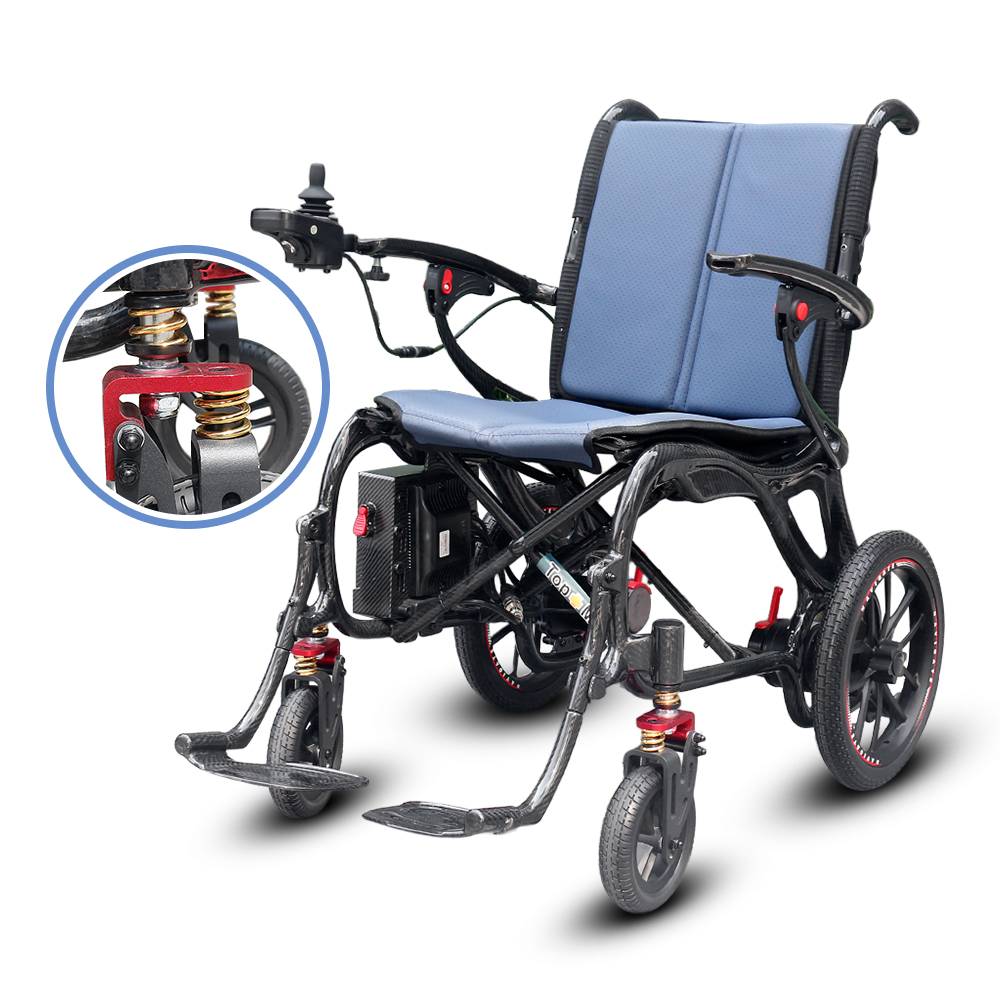
For Topmedi, which has spent two decades evolving from a traditional manufacturer to a global innovator — serving over 100 countries with products that include carbon fiber electric wheelchairs under 10 kg, sports wheelchairs for basketball, tennis, racing, and badminton, as well as advanced patient transfer and nursing equipment — the next material revolution represents both a challenge and an opportunity.
The companies that will lead this revolution are those that combine materials science with human-centered design, asking not just “What’s the lightest material?” but “What material best serves the user’s lifestyle, independence, and dignity?” As experts in complex rehab technology have observed, the focus is not only on the medical clinical technology but also on how it can be a better user experience overall.
Carbon fiber was the beginning. The revolution is just getting started.
The product has good colorfastness. During the production, it has been dipped into or sprayed with quality coatings or paint on the surface.